Desktop shell
AncestryLLM 0.6.0 includes a bounded, offline Electron control shell. It does not move the genealogy-capable CLI or console into the desktop application and it does not introduce a second command or domain layer.
The desktop architecture decision, ADR-0025 owns the process boundary, and the data-flow threat model owns its security controls. The sidecar’s authenticated loopback channel is not a public or LAN API. Electron Main keeps the launch secret and OS keyring operations outside the sandboxed renderer, turns user-selected files into opaque grants, and lets backend-owned cancellation finish at a declared safe point.
For a source-level v0.6 learning path, start with Desktop first run, use the focused desktop how-to guides, and keep the desktop reference open for exact states and stable codes. These pages describe the current source contracts; they do not expand the supported 0.6.0 installer claim below.
Supported surface
The supported desktop destinations are deliberately small:
- Home identifies the application, its offline posture, and sanitized startup and capability state. The capability summary reports only whether the bundled local runtime is ready; it does not expose accounts, providers, credentials, genealogy data, or cloud consent.
- Diagnostics shows stable, sanitized lifecycle state and offers bounded retry or restart recovery.
- Settings stores local visual preferences only: color scheme and reduced motion. The internal onboarding flag is not a user-facing setting.
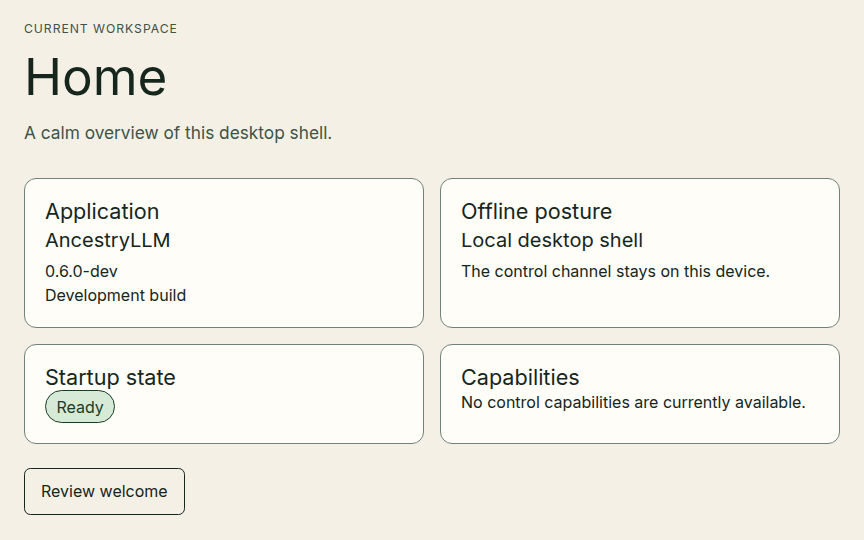
The 0.6.0 source from Issue #109 adds a Tasks destination to present backend-owned work. It remains outside the supported 0.6.0 installer claim.
The 0.6.0 source from Issue #110 adds an internal, synchronous, transient-chat service and fixed sidecar routes. Issue #111 adds the audited source transport owned by Electron Main. Issue #112 adds the bounded Chat destination over six fixed chat methods and one event listener. It does not add a tool call, genealogy operation, renderer network client, persistent transcript, or generic dispatch surface.
These destinations must remain usable with keyboard navigation and assistive technology, and in loading, empty, degraded, failure, narrow-window, and zoomed layouts.
Accessible design-system shell
The 0.6.0 source from Issue #106 implements the reusable presentation shell for the desktop work. It preserves a persistent primary navigation region, workspace header, context-and-help panel, and explicit Local and offline status across Home, Diagnostics, Settings, and the source-level gated Tasks and Chat destinations. The compact layout keeps the current route and local status visible when the window narrows; at the 720-by-560 minimum size and 200% zoom, primary actions reflow without horizontal clipping.
The shell exposes one typed route and navigation contract rather than another command registry. Ctrl+K or Command+K opens a keyboard destination palette. Its filter receives initial focus, Escape dismisses it and restores the trigger, and choosing a destination focuses that route’s heading. A Skip to workspace link is the first backward-reachable control when route focus starts on a heading. Focus indicators, reduced-motion preferences, and forced-color behavior are explicit rather than dependent on browser defaults.
Shared presentation contracts live under
desktop/src/renderer/src/design-system/:
AppRouteandNavigationItemdefine the bounded destinations and labels.CapabilityGatepresents an already-authorized branch; it cannot create or infer authority.AsyncStateprovides plain-language loading, empty, offline, degraded, error, success, and permission-denied patterns. Meaning is always conveyed by text and semantics, not color alone.CodedErrorViewaccepts only stable coded errors, normalizes an unexpected code toUNEXPECTED_ERROR, and keeps recovery instructions beside the code.- The dialog-focus contract records initial, dismiss, restoration, and route-selection behavior for keyboard regression tests.
These components import no bridge, Electron, Node.js, filesystem, or network API. They consume data only when a route-level hook passes a validated bridge response. The development gallery imports deterministic fictional fixtures, while the production build verifier rejects the gallery and its copy from the shipping renderer.
First run and revisit
The 0.6.0 source-level gated first launch opens a bounded welcome on Home
and presents three explicit deployment intents:
- Local Desktop (Recommended) is the only available choice. It uses the private loopback sidecar and offline-first defaults on this device.
- Connect Remote is visible but unavailable in this release. First run does not discover or contact a remote service.
- Host Remote is an advanced intent that is visible but unavailable. First run never opens a listener or starts a container.
The welcome explains that updates are installed manually and asks for no account, provider, API key, genealogy data, or cloud consent. Before it enables Continue, the renderer validates a schema-v1 startup report containing exactly four components: configuration, SQLCipher, keyring, and workspace. Each component contains only a stable status, code, reviewed message, remediation, restart requirement, and mutation-blocking flag. The report also contains only normalized operating-system and architecture labels.
When a required component blocks startup, the application remains navigable
but read-only. Open read-only diagnostics replaces Continue;
capabilities are not queried, and preference, settings, and credential
mutations are rejected with STARTUP_MUTATION_BLOCKED. Inspection does not
repair configuration, create a workspace or database, replace a database key,
or select a plaintext fallback. One bounded retry is available, concurrent
requests share that launch attempt, and relaunch remains the final local
recovery step.
Continue records only the main-process-owned onboardingCompleted
preference. A new application process skips the welcome after a valid refreshed
preference snapshot reports completion; the flag is not exposed in Settings.
Conflict, unavailable, corrupt, unsupported, or invalid preference responses
fail closed and keep the welcome gated with a stable sanitized code and bounded
Try again, Diagnostics, or restart recovery. The renderer never repairs
or overwrites invalid preference storage.
Completed users can select Review welcome on Home. Review is temporary renderer state: Back to Home neither creates a route nor changes a preference. Keyboard focus begins on the welcome heading, reduced-motion preferences are respected, and degraded runtime state does not block navigation to Diagnostics or its bounded retry.
The supported 0.6.0 shell has no genealogy, file or folder, GEDCOM or RootsMagic, job, chat, provider or credential, cloud or account, domain-dispatch, updater, or background-channel surface. Those exclusions apply to navigation and hidden controls as well as visible content.
Offline and process boundary
Electron starts the packaged sidecar on a private, ephemeral loopback endpoint
from the network-free provider=none baseline; the Electron main process is
the sole authenticated client. Issue #110’s internal chat boundary can execute
only after a caller supplies an exact stored profile and model and the Python
service rechecks endpoint policy and any required consent. Ambient credentials
cannot select a provider. The preload bridge exposes exactly these six methods:
getAppInfogetStartupDiagnosticsgetCapabilitiesretrySidecargetPreferencesupdatePreferences
The source-level gated 0.6.0 additions are fixed, separately reviewed contracts and do not change that supported six-method claim. Issue #109 contributes five task request methods and one validated event listener. Issue #111 contributes three chat-stream request methods and one validated event listener. Issue #112 contributes three chat-lifecycle methods and two fixed native actions for confirmed HTTPS links and plain-text copy.
The renderer receives no Node.js, Electron, network, filesystem, keyring, provider, database, shell, or arbitrary-path access. It must never receive the sidecar port, bearer token, endpoint, executable path, preference-file path, stderr, raw sidecar or bridge errors, or stack traces. See the packaged sidecar contract and desktop ADR for the underlying process and architecture controls.
Source-level gated task center and safe shutdown
Issue #104 supplies the UI-neutral Python lifecycle: strict schema-v1 snapshots
and events, increasing per-job sequence numbers, bounded persistence and
replay, cooperative cancellation, and exactly one terminal result. A
reconnecting internal client resumes from Last-Event-ID; an expired replay
window fails with JOB_EVENT_REPLAY_EXPIRED instead of silently skipping
progress.
Issue #109 presents that lifecycle through five fixed request methods—list, get, cancel, subscribe, and unsubscribe—and one validated event listener. The backend remains authoritative. The renderer loads complete sanitized snapshots, ignores duplicate or stale sequence numbers, and refreshes and resubscribes when it detects a gap or expired replay cursor. A reload reconstructs the view from the backend rather than renderer storage, and each terminal delivery closes its subscription. Multiple jobs may be shown at once. Progress is determinate only when the snapshot supplies a trustworthy total; otherwise the view explicitly reports indeterminate progress.
The lifecycle distinguishes queued, running, cancelling, pending-safe-point, completed, failed, and cancelled states. Progress may be determinate or indeterminate. Cancellation is a request: a job inside an atomic publication section remains pending at its declared safe point rather than abandoning or corrupting output. Non-terminal persisted work is reconciled to one sanitized interrupted terminal result when the sidecar restarts.
One polite, atomic live region announces only meaningful lifecycle changes. Failures contain a stable code, reviewed message, and bounded remediation—never stacks, paths, records, prompts, responses, or raw backend content. Artifact cards contain only type, media type, byte size, and status. They expose no path, grant identifier, digest, or direct open action; any future artifact access must pass through Issue #103’s main-owned grant boundary. Tasks admits no work and adds no producer, provider call, genealogy operation, or domain route.
When the user quits while work is active, Electron main—not the renderer—uses an authenticated shutdown preflight and presents native Wait, Request cancellation, and Stay open choices. Wait keeps the application open until jobs drain within the bounded deadline; Request cancellation asks interruptible jobs to stop and explains any pending safe point; Stay open aborts the quit. A degraded sidecar startup has no admitted local jobs, so its sanitized empty shutdown assessment is safe only before the supervisor has ever exposed an authenticated session. Electron owns that supervisor before asynchronous verification or launch, and shutdown cancels pre-spawn work and drains any launch already in flight. Losing a previously exposed session never restores the empty shortcut. The IPC boundary remains intact when sidecar shutdown fails, allowing a subsequent bounded recovery attempt. Once jobs are safe, Main invalidates the public sidecar session before making one exact, authenticated, bodyless runtime-shutdown request with captured credentials. It must independently observe the sidecar exit; a response alone cannot authorize application exit, and the bounded full-tree termination path remains the fail-closed fallback.
Source-level gated transient-chat foundation
Issue #110 defines one schema-v1 Python service contract for short-lived chat
sessions and one fixed synchronous run operation. Session creation accepts an
exact stored profile and model plus reviewed purpose and data-class values. It
rejects direct provider identifiers, provider=none, missing or incompatible
profiles, missing credentials, failed endpoint revalidation, and missing or
revoked cloud consent before provider generation can begin. Consent is fetched
again for every run, so a grant revoked after session creation fails closed.
The service permits at most 32 concurrent sessions, 32 stored messages per session, 16,384 characters per message, 65,536 characters of total context, 4,096 output tokens, one safe retry, and a 120-second timeout. Those bounds, the exact profile/model binding, and the no-tool request shape are validated before provider access. A fixed system instruction treats user and prior model content as untrusted data, denies tools, files, databases, shells, plugins, external services, and autonomous actions, and labels generated text as advisory rather than genealogy evidence.
Sessions and successful message history exist only in process memory. Failed runs do not append history, deletion clears the session, and sidecar shutdown clears every remaining session. Audit records retain only reviewed identifiers, counters, and content hashes; they do not retain prompts, responses, secrets, host identity, or local paths.
Issue #111 extends that boundary with owner-scoped schema-v1 lifecycle events and a 256 KiB in-memory replay budget. Electron Main alone owns the authenticated SSE connection and rejects redirects, an unexpected media type, the wrong owner or run, malformed events, and non-monotonic sequences. It batches events for no more than 16 milliseconds or 4 KiB, counts the exact UTF-8 JSON bytes sent but not acknowledged, pauses at 256 KiB, and cancels with a stable coded outcome if the renderer remains stalled for 15 seconds. One reconnect may resume the same run from its last cursor; provider generation is never retried after output begins. Shutdown, reload, and startup reconciliation record one payload-free terminal audit outcome. Preload exposes only fixed start, cancel, acknowledge, and event contracts.
Issue #112 adds the renderer-owned Chat destination. A conversation is created only after the user selects a compatible named profile, model, and consent. The workspace exposes multiline composition, stop, regenerate, usage placeholders, plain-text copy, and one screen-reader announcement path. It holds at most 24 visible turns in transient memory and closes its sidecar session on teardown; it does not write conversations to renderer storage.
Model text is parsed through react-markdown and remark-gfm with a closed
component allowlist. Raw HTML, images, embeds, implicit autolinks, executable
actions, and renderer-side navigation are disabled. A rendered HTTPS link shows
its normalized destination and must cross the fixed native action so Electron
Main can display that exact destination and obtain confirmation. The renderer
never calls window.open; copy writes plain text only. Ordered sequence,
duplicate, replay, gap, interruption, and owner-mismatch tests keep stream state
fail closed. Target-matched packaged accessibility, stream-race, and hostile
content evidence remains Issue #131.
Source-level gated opaque file-mediation foundation
Issue #103 adds a security boundary for later genealogy workflows without expanding the supported 0.6.0 domain surface. The bridge gains only three strict, asynchronous methods:
requestOpenFileGrantrequestSaveFileGrantrevokeFileGrant
The renderer requests an exact purpose and receives either a cancelled result or a path-free grant containing a random opaque identifier and safe display metadata: basename, kind, byte size, and replacement status. It cannot provide, receive, reconstruct, persist, or redeem a pathname, and it has no direct filesystem method. The reusable selected-file card does not initiate a domain operation.
Electron main owns the native open/save dialogs and the grant-to-path map. It checks the selected object’s regular-file and link state, purpose-specific extension and content signature, bounded size, canonical identity, and filesystem fingerprint. Grants are bound to the requesting renderer, exact purpose and access mode, current application session, and one redemption. Explicit revocation, renderer close or cross-document navigation, and application restart invalidate them. Trusted same-document routes such as the application’s hash-based Home, Tasks, Diagnostics, and Settings transitions preserve the renderer identity and its grants; each bridge request still rechecks the exact main frame and trusted application URL. Existing-output replacement requires a native confirmation and identity revalidation; source/output aliases and concurrent output grants fail closed under main-owned locks.
Only a trusted main-process adapter may redeem a grant through
resolveReadGrant or resolveWriteGrant. A future genealogy integration must
then pass the internal path to the shared Python file-ingress adapter, which
reopens and revalidates the source under its own bounded policy before parsing
or publication. Until that adapter ships, the grant broker provides no GEDCOM,
RootsMagic, import, export, or report workflow.
Source-level gated settings and credential-management foundation
Issue #105 adds the 0.6.0 source-level settings and credential-management boundary. It does not expand the supported 0.6.0 shell and does not enable provider execution, cloud consent, genealogy operations, or arbitrary sidecar access.
The renderer can read the complete versioned settings catalog and submit one
exact optimistic-revision patch. The catalog exposes only five reviewed,
non-secret settings: the default provider choice and four bounded query/output
limits. Each entry supplies its label, help text, type, safe default, allowed
values or numeric bounds, restart requirement, sensitivity marker, and current
value. The Python SettingsService validates the whole update before
AppConfig atomically replaces the repository-owned configuration; unknown,
sensitive, invalid, or stale-revision changes fail closed.
Credential controls are intentionally write-only. The bridge adds only these five fixed operations:
getSettingsupdateSettingsgetSecretStatussetSecretdeleteSecret
Secret references are selected from a fixed Python-owned allowlist. Reads
return only present, missing, or unavailable; no response can return a
credential value. Save and delete require separate explicit actions, and a
successful delete is reported only after the OS-keyring-backed store proves
the credential is absent. The packaged sidecar uses keyring-only secret
resolution and never consults process-environment credentials. The documented
read-only environment fallback remains available only to explicit CLI and
headless workflows. An unavailable or locked keyring, or any attempted
plaintext fallback, produces a stable redacted failure.
The renderer’s password field is uncontrolled and is cleared before the
asynchronous request begins and again after every success or failure. Secret
values are never retained in React state, query caches, bridge fixtures,
responses, logs, local storage, IndexedDB, Electron safeStorage, or plaintext
configuration. The renderer still has no direct keyring or network access.
Together with the three source-level gated file-grant methods, the 0.6.0
source bridge therefore contains thirty-six fixed request methods: six
supported control methods, three opaque file-grant methods, five
settings/credential methods, six
provider-configuration methods, five task-lifecycle methods, three local-runtime
methods, two native actions, and six chat methods. Issue #109 adds one fixed,
validated onJobEvent listener, and Issue #111 adds one fixed, validated
onChatEventBatch listener. There is still no generic send, listen,
route-selection, clipboard, shell, or command operation.
The 0.6.0 source implements the non-secret, versioned deployment-profile
control plane accepted by the
deployment-profile ADR.
Local Desktop is preselected and recommended. The shared Python service owns
profile validation, exact preview and confirmation, atomic persistence,
diagnostics, redacted evidence, and recovery to Local Desktop. Issue #107 now
presents that local-only choice during first run and gates mutations on the
sanitized startup report. Issue #108 presents provider configuration and
consent separately from that deployment choice. Connect Remote and Host Remote
remain visible advanced intents,
but neither can be activated until its enrollment or host-runtime dependency is
implemented and independently gated.
Selecting or inspecting a profile does not open a listener, start a container, discover a service, move genealogy data, select a provider, or grant cloud consent. The supported 0.6.0 shell still has no supported container, remote, LAN, browser, or public-service surface. Future presentation keeps the renderer sandbox and fixed typed bridge, while authority remains in the shared service contracts and Electron Main’s narrow adapter.
Source-level gated provider configuration and consent
Issue #108 adds separate Local Providers, Cloud Providers, and Consent & Privacy sections. It remains an administrative surface: it does not run a provider request, a genealogy workflow, or a deployment profile. Six fixed bridge methods reach six exact authenticated sidecar routes:
getProviderConfigurationvalidateProviderEndpointcreateProviderProfilepreviewConsentcreateConsentrevokeConsent
Local Ollama profiles accept only an explicitly tested loopback endpoint. Cloud profiles use the exact reviewed built-in HTTPS endpoint. Endpoint tests deny redirects and proxy inheritance, connect directly to the resolved numeric address while retaining TLS hostname verification, repeat DNS resolution, and return only a redacted destination digest. Profile save, consent creation, and provider execution recheck that identity; a missing, stale, or changed test fails closed. Profile writes also require the current optimistic revision.
Consent preview discloses the exact provider, profile, model, allowed modules, purposes, data classes, retention choice, warnings, and optional budget before creation. Living-person data and remote retention receive explicit warnings. Creation accepts only the current revision and exact preview, and revocation is explicit. Secret values remain in the Issue #105 write-only keyring boundary: provider configuration returns presence only, and a stored key alone cannot select a provider or grant consent.
The 0.6.0 source from Issue #363 adds the host-only control foundation inside
Electron Main. Its closed schema-v1 policy and plan bind an app-owned Docker context,
Unix socket, runtime profile, Engine identity, exact resource labels, immutable
images, and hardened Compose settings to bounded lifecycle operations. Issue
#348 wires only acquisition and lifecycle of the local macOS arm64 tool
substrate to Settings and three fixed bridge methods; it does not start an
AncestryLLM application image or activate a deployment profile. The preload and
renderer expose no supervisor, socket, context, executable path, environment,
arbitrary argument, or generic process method. The native macOS arm64
issue-363-macos-arm64-container-supervisor.json
record proves only that control subset in an isolated Colima profile. Runtime
application images, secret delivery, family-tree grants, storage, profile
activation, budgets, cross-platform evidence, and the remaining G5 and G7
gates still block any application-container availability claim.
macOS arm64 local-runtime management
Issue #348 supports only Apple silicon hosts running macOS 13 or later. Setup, start, and repair first prove hardware virtualization is available and at least 24 GiB is free. The manager does not request administrator privileges, invoke a package manager, use an ambient executable, or install a system service. Docker Desktop is optional: an existing installation may coexist, but AncestryLLM neither selects nor modifies its context, configuration, socket, or files.
Open Settings > Local container runtime to inspect status. Every mutation has two separate actions: Review produces an exact revision-bound plan, and Apply remains disabled until the operation-specific confirmation is typed. The supported operations and phrases are:
| Operation | Effect | Exact confirmation |
|---|---|---|
setup |
Verify and install the app-owned tools and create the isolated profile. | SET UP LOCAL RUNTIME |
start |
Start only the verified app-owned profile. | START LOCAL RUNTIME |
stop |
Stop only that profile without deleting it. | STOP LOCAL RUNTIME |
repair |
Reverify tools and recreate only owned runtime state. | REPAIR LOCAL RUNTIME |
uninstall-preserve |
Remove tools and runtime infrastructure but preserve app data and downloaded cache. | REMOVE LOCAL RUNTIME |
uninstall-delete |
Remove owned tools, infrastructure, cache, and delete app data. | DELETE LOCAL RUNTIME DATA |
The packaged application also exposes an equivalent noninteractive interface.
The executable writes exactly one JSON line: exit code 0 means the requested
operation succeeded, exit code 1 is a sanitized runtime or control failure, and
exit code 2 means the command arguments were invalid. Obtain a fresh preview
before applying and copy its planRevision exactly:
AncestryLLM --local-runtime status
AncestryLLM --local-runtime preview setup --offline
AncestryLLM --local-runtime apply setup --offline --plan-revision \
  <64-lowercase-hex-plan-revision> --confirm 'SET UP LOCAL RUNTIME'
The desktop UI and noninteractive commands share one process lock so separate
processes cannot race over the same application-owned runtime. A command started
while another AncestryLLM process holds that lock exits with code 1 and the stable
sanitized code BRIDGE_OVERLOADED; wait for the active process to finish and
retry.
Replace setup and its phrase with any operation from the table. --offline
forbids network access and succeeds only when every required artifact is
already complete and reverified. Without that flag, interrupted transfers use
bounded .part files and resume on retry; network loss, cancellation, reboot,
or a partial setup can therefore be retried through a new review without
executing incomplete bytes. A changed policy, status, cache, or plan invalidates
the old revision and requires another review. Diagnostics contain only stable
local-runtime codes, normalized platform/architecture, component versions,
hashes, and reviewed remediation. They exclude usernames, hostnames, absolute
paths, environment values, process output, response bodies, and tokens.
The manager owns profile ancestryllm-local-arm64, context
colima-ancestryllm-local-arm64, its Docker configuration, and a Unix socket
beneath application-owned storage. Kubernetes, public address publication, and
privileged mode are disabled. Ambient Docker context and configuration are
ignored. Neither the renderer nor a container receives the socket. Removal
first verifies ownership; choose preserve app data for recoverable removal
or delete app data only after reviewing the explicit destructive plan.
Runtime policy updates
desktop/resources/macos-arm64-runtime-policy-v1.json is the only supported
policy. A reviewed update must change the version, repository, asset name,
source URL, byte size, SHA-256, license identity, and license digest together
for each affected component. Reviewers must obtain those values from the named
upstream release and license, regenerate focused fixtures, run extraction and
package-resource contracts, and record why every identity changed. There is no
implicit latest version, no mirror fallback, no alternate source or
architecture, and no unverified PATH fallback. Unknown schemas, fields,
platforms, archives, or omitted trust data fail closed. Downloaded artifacts
cannot execute before exact byte-size and SHA-256 verification, and extracted
members cannot publish until archive-safety and expected-executable checks
pass.
Installation and updates
The supported 0.6.0 targets are macOS 15 and 26 on arm64 and x64, Windows 11
on arm64, and Ubuntu 24.04 on x64. A supported release is a manually installed
installer that has passed the target-specific release and packaged assurance
gates in the release runbook. Full production/trusted binary
signing is explicitly deferred until the first full version release, v1.0.0.
Project-produced 0.x release installers and annotated release tags must be
unsigned.
Unpacked CI artifacts and development builds are verification inputs, not
supported releases or evidence of installation. For an install or upgrade,
quit AncestryLLM; download the target-matched full installer and SHA256SUMS
from the same immutable release;
verify its digest and declared binarySigningMode; install it over the current
application; relaunch; and confirm the version and healthy Diagnostics. A
0.x binary may produce an unknown-publisher or equivalent operating-system
prompt. At v1.0.0 and later, also verify the trusted platform signature;
Ubuntu then requires the adjacent .deb.asc detached GPG signature.
Application files are replaced while OS-managed AncestryLLM data and
configuration directories are retained.
Version 0.6.0 has no updater feed, no background update, no staged rollout, and
no automatic rollback. It publishes no latest*.yml or blockmap. Updating and
rolling back mean manually installing an appropriate complete installer whose
checksum and version-required platform signature still verify.
Sanitized diagnostics and recovery
When startup is degraded, use the reviewed remediation beside the affected configuration, SQLCipher, keyring, or workspace code. The report never includes a username, hostname, full path, environment value, record, prompt, payload, response body, raw exception, or stack. Keep recovery bounded and generic:
- Open read-only Diagnostics and review the stable component code.
- Correct only the named local prerequisite. Unlock or repair the OS keyring; install the supported SQLCipher build; restore valid configuration; or repair the app-owned workspace directory and owner-only permissions.
- Request the one bounded retry. Do not initialize a replacement database, replace an existing key, or use plaintext SQLite as recovery.
- If the failure remains, close and reopen the application.
- Reinstall the same supported, target-matched build when the sidecar version or local application files may be incomplete.
- When reporting a problem, include only the application version, normalized operating-system and architecture labels, and stable diagnostic code shown by the shell. Do not include local paths, environment values, process details, genealogy data, or raw error output.
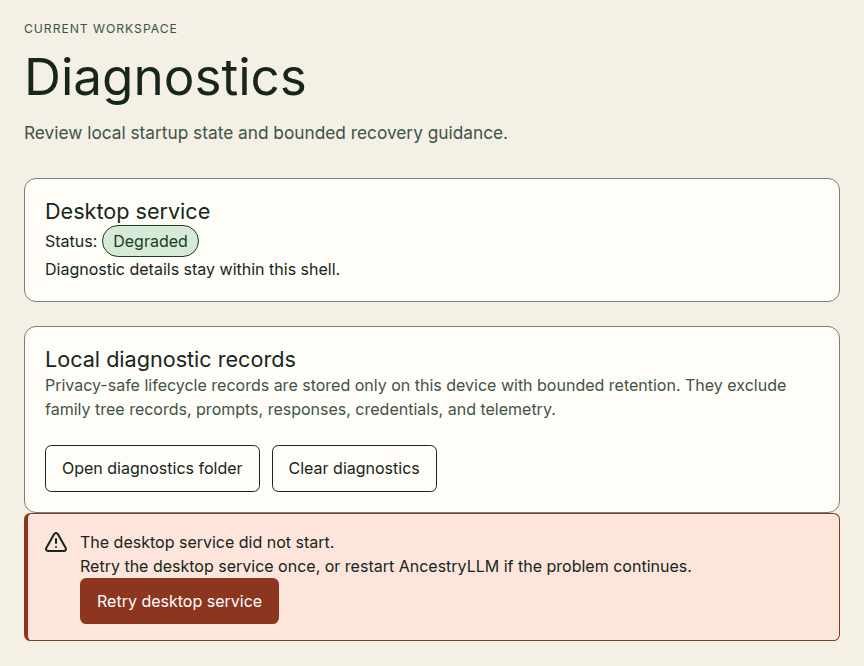
Generic recovery text is part of the security boundary: the capability summary and diagnostics must not turn private runtime state into renderer-visible details.
Deterministic documentation capture
The two reviewed Electron screenshots are published from the
shared manifest. make docs-screenshots captures every declared scenario into
an isolated staging tree, validates its inclusion, crop, 144-dpi PNG quality,
ownership, and privacy contract, and
publishes the complete set transactionally. make docs-screenshots-check
recaptures into a temporary tree and fails on any missing, changed, undeclared,
or orphaned asset without modifying the checkout.
The Electron adapter launches the real shell through Playwright and drives the ordinary Home and Diagnostics destinations using only checked-in fictional, network-disabled fixtures. It blocks unexpected renderer networking, scans rendered text for the privacy canary, and waits for each declared visible ready signal under the fixed viewport, font, locale, timezone, and theme controls. See the documentation authoring guide for selective capture, drift evidence, review, and update procedures.
Verification boundary
make desktop-e2e builds the production renderer and launches it in Electron
with a deterministic fictional mock bridge. The flow proves welcome completion,
renderer reload, revisit, degraded startup, retry, destination access,
deterministic route/dialog focus, and minimum-window behavior at 200% zoom. The
real Chromium run also scans every route in light, dark, and high-contrast
modes against WCAG 2.2 A/AA rules from the exact locked axe-core version. A
separate FilePreferencesStore unit test proves that completion survives a
fresh store instance, which models a new application process.
Use the focused checks during shell review:
pnpm --dir desktop test:accessibility
pnpm --dir desktop test:visual
pnpm --dir desktop dev:gallery
Automated checks do not replace a screen reader. Before release credit, review the production shell and fictional gallery with VoiceOver, NVDA, or Narrator and record the operating system, reader and version, commit, and result in the release evidence. The smoke review must confirm:
- Landmarks, the heading hierarchy, Primary navigation, the current-page announcement, and Local and offline status are understandable without visual position or color.
- Route entry focuses the workspace heading; the skip link reaches the workspace; and focus never becomes lost behind navigation or context panels.
- The destination palette announces its dialog and label, focuses its filter, reports an empty search, restores its trigger on dismissal, and focuses the selected route heading.
- Every gallery state announces its state label, title, description, and code where present without exposing a path or private runtime detail.
- The minimum window at 200% zoom, light/dark/high-contrast themes, and reduced motion retain all primary actions and understandable focus order.
The exact-head desktop verification gate separately assembles and launches the literal unpublished unpacked executable on six hosted runner rows, exercises healthy first run, durable settings, corrupt preferences, accessibility and hardening controls, and inspects the packaged fuses. It does not launch an installer. Manual installation and actual Windows 11 execution remain separate release gates; trusted signing becomes a release gate at v1.0.0.
Issue #105’s source suites additionally verify revision conflicts, strict settings metadata, write-only secret schemas, keyring failure behavior, credential deletion, bridge redaction, and password-field lifetime. Packaged settings and credential-management evidence remains owned by the 0.6 desktop verification work; source tests alone do not make the feature released.